



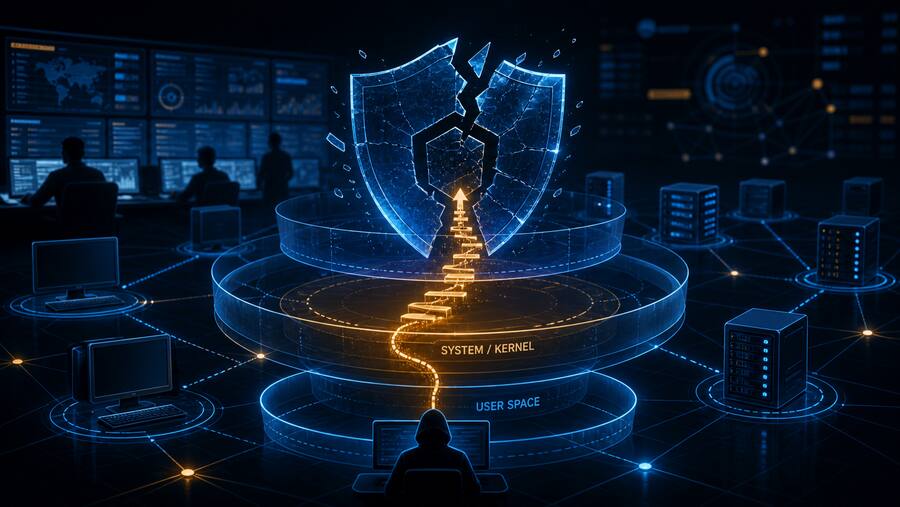










A newly disclosed Network UPS Tools (NUT) vulnerability is a good reminder that “supporting infrastructure” is still infrastructure. CVE-2026-54161 affects the upsmon component in NUT 2.8.3 through 2.8.5 and can turn a UPS alarm notification into operating-system command execution when a common notification pattern is enabled.
The original oss-sec disclosure describes a remote command-injection path through ups.alarm when NOTIFYCMD is configured and NOTIFYFLAG ALARM ... EXEC is used. In plain English: if a monitored UPS reports an alarm, upsmon may pass attacker-controlled alarm text into a shell command. A malicious or compromised upsd server, a man-in-the-middle on plaintext TCP/3493, or a rogue UPS device capable of setting alarm text could abuse that path.
Source: oss-sec disclosure for CVE-2026-54161.
Why this matters
UPS monitoring usually lives in the operational gray zone: installed years ago, rarely reviewed, and trusted because it supports availability instead of business logic. That makes it easy to underestimate. But NUT often sits close to server rooms, virtualization hosts, storage, network gear, labs, telecom closets, industrial control support systems, and small government-contractor environments where power stability matters.
The vulnerability is not “internet-scale ransomware tomorrow” by itself. The realistic risk is more operational: an attacker who can influence the UPS monitoring path may gain command execution as the NUT service account on POSIX systems, or potentially a more dangerous context on Windows depending on deployment. From there, the value is foothold, persistence, reconnaissance, and disruption inside infrastructure most teams do not actively monitor.
The control-plane lesson
Security teams often prioritize externally exposed web apps, identity providers, VPNs, RMM platforms, and cloud consoles. That is correct, but incomplete. Monitoring systems are also control planes. They collect privileged operational data, trigger scripts, run services, and often bridge IT and facilities networks. When a monitoring tool can execute commands based on remote device state, every field that enters that workflow becomes security-sensitive input.
CVE-2026-54161 is a clean example of that pattern. The dangerous part is not simply that a UPS can raise an alarm. It is that alarm text traveled into a command execution path. The fix changes the execution model so the notification command receives alarm data as a literal argument instead of letting the shell interpret it.
Defensive takeaways
- Patch or backport the fix. Prioritize NUT 2.8.3, 2.8.4, and 2.8.5 deployments. The disclosure says 2.8.2 and earlier are not affected by this specific bug, but older software still deserves normal lifecycle review.
- Inventory
NOTIFYCMDusage. Look forNOTIFYFLAG ALARMwithEXEC. If notification scripts are not required, disable command execution. If they are required, review exactly what runs and under which account. - Segment UPS management traffic. Treat TCP/3493 and UPS management paths like infrastructure management, not generic LAN noise. Restrict which hosts can talk to
upsdand which monitoring servers can receive UPS data. - Avoid plaintext trust where possible. The disclosure calls out man-in-the-middle risk on plaintext connections. If your deployment relies on unauthenticated or weakly protected monitoring links, assume alarm data can be manipulated.
- Monitor child processes from monitoring services. Alert when
upsmon,upsd, or notification wrapper scripts spawn shells, interpreters, curl/wget, netcat, PowerShell, or unexpected administrative utilities. - Keep service accounts constrained. The NUT account should not have broad write access, sudo rights, domain privileges, or access to secrets. If command execution happens, damage should be contained.
Bulwark Black assessment
This is the kind of vulnerability that matters more than its headline suggests. It sits at the intersection of availability tooling, facilities infrastructure, and command automation. For SMBs and government contractors, the practical move is not panic; it is disciplined infrastructure hygiene: know where NUT runs, patch affected versions, restrict UPS monitoring paths, and remove shell-based notification assumptions wherever possible.
The broader lesson is simple: if a system can trigger scripts automatically, it belongs in the same review process as any other privileged control plane.